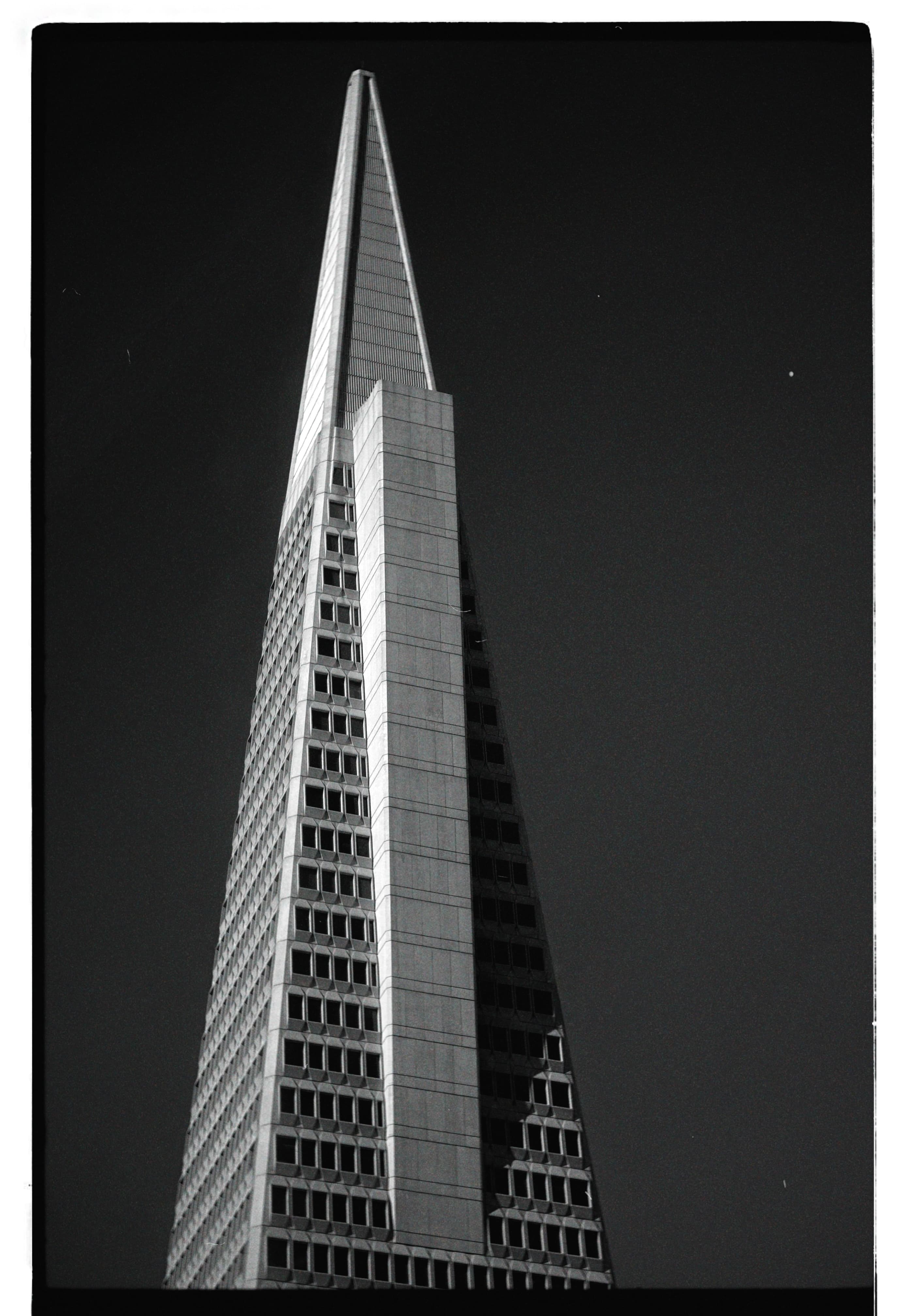
Transamerica Pyramid
Research
Architecture History
-
Transamerica Pyramid | History, Description, Height, Renovation, & Facts | Britannica Provides essential detail on the building's white precast quartz-aggregate cladding, its conceptual derivation from redwood tree forms allowing light to the forest floor, and the controversial sale of public space—all directly relevant to questions of material surface and the spatial envelope's relationship to the street.
-
Story of a City Block: Foster + Partners and the Transamerica Pyramid | +Plus Journal An architecturally literate historical essay situating the Pyramid within a lineage of corporate headquarters design from Mies to Foster, tracing how Pereira rejected the repetitive fenestration of International Style boxes in favor of a classical silhouette—pertinent to understanding the building's material and enclosure strategies as departures from normative curtain-wall tectonics.
-
Transamerica Pyramid Center by William Pereira & Foster + Partners | ArchEyes Documents both Pereira's original design and Foster + Partners' 2020–2024 renovation with technical specificity—including crushed-quartz façade, 3,678 pivoting windows, the hollow spire core, and the 9-foot-thick concrete base—offering substantive material on the building's tectonic and enclosure systems.
-
Architecture Behind Transamerica Pyramid – San Francisco, CA: Design and Innovation Details the precast quartz-aggregate panel system, the tapered structural armature, seismic engineering strategies, and the relationship between the pyramid form and interior spatial distribution—directly engaging questions of materiality, structural honesty, and spatial containment.
-
AD Classics: Geisel Library / William L. Pereira & Associates | ArchDaily Illuminates Pereira's broader design methodology—his analysis of massing, circulation, and programmatic form culminating in expressive concrete structures—providing essential context for understanding his approach to material expression and spatial enclosure as applied to the Transamerica Pyramid.
Critical Theory
-
Transamerica Building: What Was All the Fuss About? (Published 1977) A contemporaneous critical assessment that directly addresses the tension between the Pyramid's flamboyant form and its material mediocrity—describing the precast concrete window units as producing 'a facade of crashing mediocrity'—while affirming the validity of a tower emphasizing height over bulk, a key critical discourse on enclosure and urban presence.
-
'An inhumane creation': The rise of the Transamerica Pyramid, once S.F.'s most hated building Chronicles the building's reception history from 'hideous nonsense' to cultural icon, documenting the critical discourse around its form, materiality, and its relationship to urban fabric—essential for understanding how the Pyramid's spatial envelope was theorized as both threat and gift to the city.
-
Which William Pereira Buildings Are Worth Preserving? Aaron Betsky positions Pereira's work between Miesian and Corbusian poles, critiquing the Transamerica Pyramid as a 'deformation of the office tube' whose exposed cores and contextual indifference raise critical questions about material honesty, tectonic expression, and the spatial autonomy of modernist enclosure.
-
The Transamerica Pyramid: From 'Architectural Butchery' to Icon A richly documented account of the Pyramid's critical trajectory, noting its white quartz exterior, over 3,000 windows, and the ideological contest between preserving urban interiority and asserting corporate spatial dominance—relevant to theorizing enclosure as both architectural and political category.
Film Theory & Architecture
-
Transamerica Pyramid - FoundSF Notes the Pyramid's cinematic appearances—including its role as visual motif in the 1978 Invasion of the Body Snatchers and time-lapse construction sequence in Zodiac (2007)—and its status as corporate product placement, offering a rare account of the building's mediation through film as spatial and material image.
-
William Pereira Documents Pereira's career as a Hollywood art director and Academy Award–winning special effects designer before becoming an architect, establishing a direct biographical link between cinematic spatial production and the futuristic material aesthetics that informed the Transamerica Pyramid's design.
-
William Pereira - LA Conservancy Details Pereira's dual career in film production design (including his Oscar for Reap the Wild Wind) and architecture, contextualizing how cinematic techniques of spatial staging and surface construction translated into his architectural practice and the Pyramid's distinctive material envelope.
-
William L. Pereira & Associates records, 1939-2022, bulk 1960-1980 - OAC An archival finding aid for Pereira's firm records at USC, including architectural plans, client presentations, and a film document—a primary research resource for scholars investigating the material and representational dimensions of the Pyramid's design process and the firm's cinematic-architectural practice.